Synthesis Essay (Final Draft)
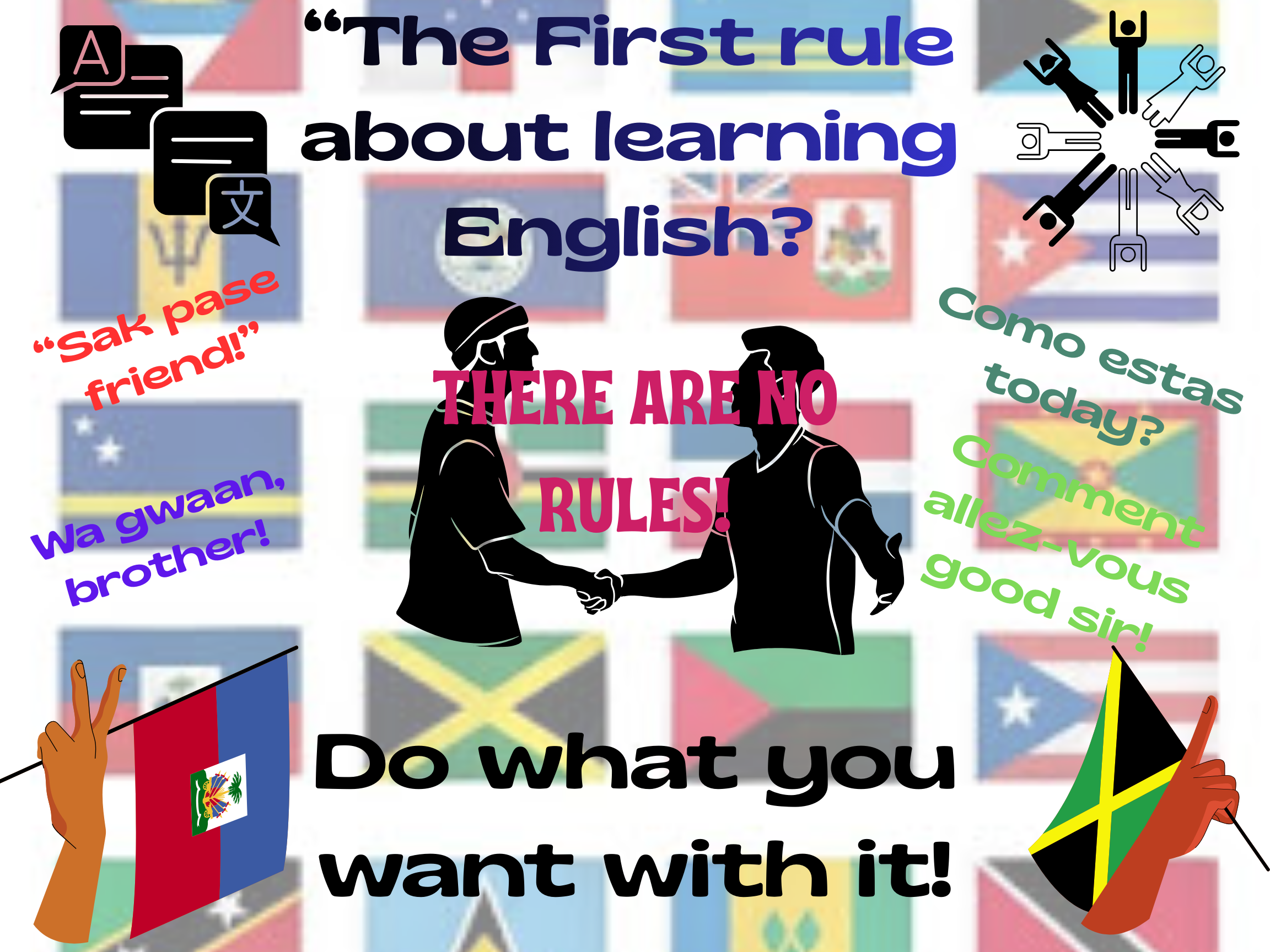
For all those who have written essays, have you enjoyed them or dreaded them? Personally I feel as I am part of the latter, I dread the concept of writing one. It feels as if I would just lose points on the small mistakes such as grammatical errors and word choice and won’t fit the premise of what the teacher would want. What does the teacher want, standard English? I always wondered why this was stressed in school and if people could still understand what I had to say, why is it wrong? This is a common problem for Caribbean immigrant children in school environments which leads to underperforming in them. This doesn’t just apply to them, it can apply to any immigrant of any descent, which shouldn’t be the case. This is why schools should allow for other forms of English in school environments and how it promotes diversity.
People often associate proficiency in English with their quality as a person. They are viewed as unprofessional or undervalued in society. It is not the case all the time and should never really be correlated. People can have something important or significant to say, but are discriminated against or not given a chance due to how they speak. It was even stated in a study by students from universities such as Penn State, University of Virginia, Ball State University, Fairfield University, and University of Michigan from 2017 that, “Discrimination disproportionately affects Black students in K-12 schools across the United States, with 87% to 94% of Black adolescents reporting experiencing discrimination of some sort from their teachers within the past 3 months to 1 year”(Perceived 1488). Some teachers often look down towards kids who can not communicate or write in standard English, which leads to negative assumptions that don’t always apply. Having limited chances in schools to perform in early stages of school can stunt growth and development in students. I along with many other black students can relate to this claim since it can be shown by teachers having a hard time understanding you. Other Black students have also reported that they’re, “being graded unfairly, discouraged from joining advanced level courses, ignored when they raised their hands, receiving more teacher referrals, subjected to harsher punishments, viewed as dishonest, threat-ening or of inferior character, accused of cheating, and held to lower academic expectations” which isn’t true for most students (Perceived 1488). Being associated with lowered expectations based upon English proficiency is not acceptable for students in these age groups. This treatment is associated with the concept of standard English and how it is normalized in schools as the status quo. This mindset is also prevalent outside of the classroom through assumptions and stereotypes. For instance, Amy Tan, the daughter of an immigrant mother, can claim that her mother’s limited English made her view her with lower regards due to her lack of proficiency (Tan 2). People often fall into that assumption since they assume that the person would understand most things since they have not taken their time to “perfect” their English. The concept of standard English clouds and narrows people’s mind to believe that this is the only way to speak English and every other option is considered invalid in professional and academic standings. Language is sometimes deemed to revolve around standard English and diversity isn’t always promoted in school environments. This shouldn’t be the case, people shouldn’t throw away and abandon their native language to assimilate with American people. We should be embracing diversity, not shunning it. Both texts associate proficiency with English to value and status, which isn’t true in most cases. They can speak or learn English just like everyone else, just in their own unique way, which isn’t a bad thing. This allows others to feel more connected to the language by making the effort to learn it and incorporate it in their daily speech, because all things considered they could just not be bothered and speak in their native tongue 24/7. They don’t, however, and that shows dedication, admirability towards English.

Multiple languages should be represented in school environments since it allows more approaches towards learning. Language allows for different perspectives and viewpoints from across the world within a single classroom. It helps immigrants transfer over to the American school while also not abandoning their native language. Amy Tan, also agrees with this statement, claiming that over time she realized that her mother’s language is “vivid, direct, and full of observation and imagery” (Tan 1). It was thereby through her mother that helped her change her output towards the world and how it was expressed differently to here (Tan 1). Even though her mother spoke differently, it didn’t lessen the value of her words. Broken language can deliver the same information and words as the standard “counterpart”. Most people, including some immigrants, just assume that standard English should be the only one stressed in schools and should take the time to be learned. This is an understandable point, and warranted due to work it takes to be even considered a pure American. However, shouldn’t pure American kids also have a chance to learn immigrant culture too? This is investigated in a PACE Newsletter where Craig Dennis, allows black children to use Haitian Creole in some of their schoolwork and it leads to interesting results. He states that this change allowed the children to “be exposed to their roots and introduce white children to the richness of another culture” and led to both cultures respect and value each other mutually. (PACE Newsletter). This is a great approach to implementing other forms of English to school and it helps broaden children’s mindsets and experiences. Blending native words with American slang allows people to diversify their language to come across multiple backgrounds. You see people in school using Jamaican slang such as “bomboclat” or “wagwan”, as common greetings or just funny words they say to their friends. That’s a sign of diversity and meshing languages together for slang and welcoming speech. According to Dennis it also has other alternative advantages such as, “minimizing the psychological problems arising from the gap between home and school” it also helps immigrant children become more proficient and fluent in English, and make it easier for these children to transition to an American school environment. (PACE Newsletter). Native languages spoken at home, and standard English enforced in schools make it hard for children to transition between the two. This leaves them confused and conflicted between languages, there was a necessity for help and guidance that just wasn’t there at most times. There are some guidelines though for those who see it as the native language overtaking the standard English, stating that “English should be introduced early and take over as the medium of instruction as soon as students are proficient enough in it” (PACE Newsletter). This enforces the use of standard English while also adding some Creole in to help for transitioning. It doesn’t even just have to be Creole, other languages can also be incorporated in school environments. You are required to take a language class in high school, why not be able to incorporate it in your writings? We are learning a language that for some won’t consider useful since they don’t use it outside of common greetings and phrases. It doesn’t have to replace standard English, but help compliment it a bit for others to be more welcomed by it. Even professors themselves follow this notion, such as Stony Brook Professor, June Jordan. In her essay she claims that different forms of English “operate inside a natural, an uncontrollable continuum of development” (Jordan 364). This means that there isn’t just standard English that runs the country, it’s every single one in their own way. The encouragement of diversity is necessary for this society, and the place where it’s most prevalent is schools, where children learn the foundations of reading and writing. The place where they learn the most and in the most need for development. Black English is stressed to be just as important as Standard English in schools since out of the thirty-five million Afro-Americans that live here, most of them depend on the implementation and creation of black English to discover and learn more about the world they live in (Jordan 363). Some cultures and nationalities depend on different languages and dialects in order to learn more about the society they live in. The constant enforcing of standard English inhibits that ability to learn, which therefore causes most immigrant children to not be as successful as their English speaking peers. Both articles stress the importance of diversity and how it can be beneficial rather than harmful to school environments. On the other hand, it could be stressed that the necessity of standard English can be considered more harmful since it causes children to be dissociated with themselves and those around them, shunning American schools rather than embracing and admiring them.
I write this to show those who are narrow-minded that other forms of English can be just as important as Standard English. To also give hope and encourage children to try and learn English, in their own way, since at the end of the day everyone learns differently. American Schools shouldn’t revolve around solely standard English for instruction and teaching. Although it is important, it shouldn’t be the only thing stressed in the curriculum. It isn’t fair for every student and it doesn’t allow for those who struggle with standard English to become better. Incorporating diversity will, and it will allow for students to become better with their English, under their own rules and experience.
Works Cited
Bryan, Julia, et al. “Perceived Teacher Discrimination and Academic Achievement Among Urban Caribbean Black and African American Youth: School Bonding and Family Support as Protective Factors.” Urban Education, vol. 57, no. 9, 2022, pp. 1487-1510, doi:10.1177/0042085918806959.
Jordan, June. “Nobody Mean More to Me Than You and the Future Life of Willie Jordan.” On Call: Political Essays, South End Press, 1985
Tan, Amy. “Mother Tongue.” The Threepenny Review, no. 43, 1990, pp. 7–8.
University of Hawai‘i at Mānoa. The Pidgins and Creoles in Education (PACE) Newsletter, no. 14. “Publications.” https://www.hawaii.edu/spcl03/pace/14-publications.htm. Accessed 30 Nov. 2025.

This entry is licensed under a Creative Commons Attribution-NonCommercial-ShareAlike 4.0 International license.